
Grading & Drainage
Standing water in the yard, a soggy strip that never dries, water running at the foundation after every storm. These are grade problems, and no amount of planting fixes them.
Upstate clay does not absorb water, it sheds it. So the job is to make sure it sheds where you want it to go instead of where gravity happens to take it.
How it’s built
Cut the high spot, fill the low one
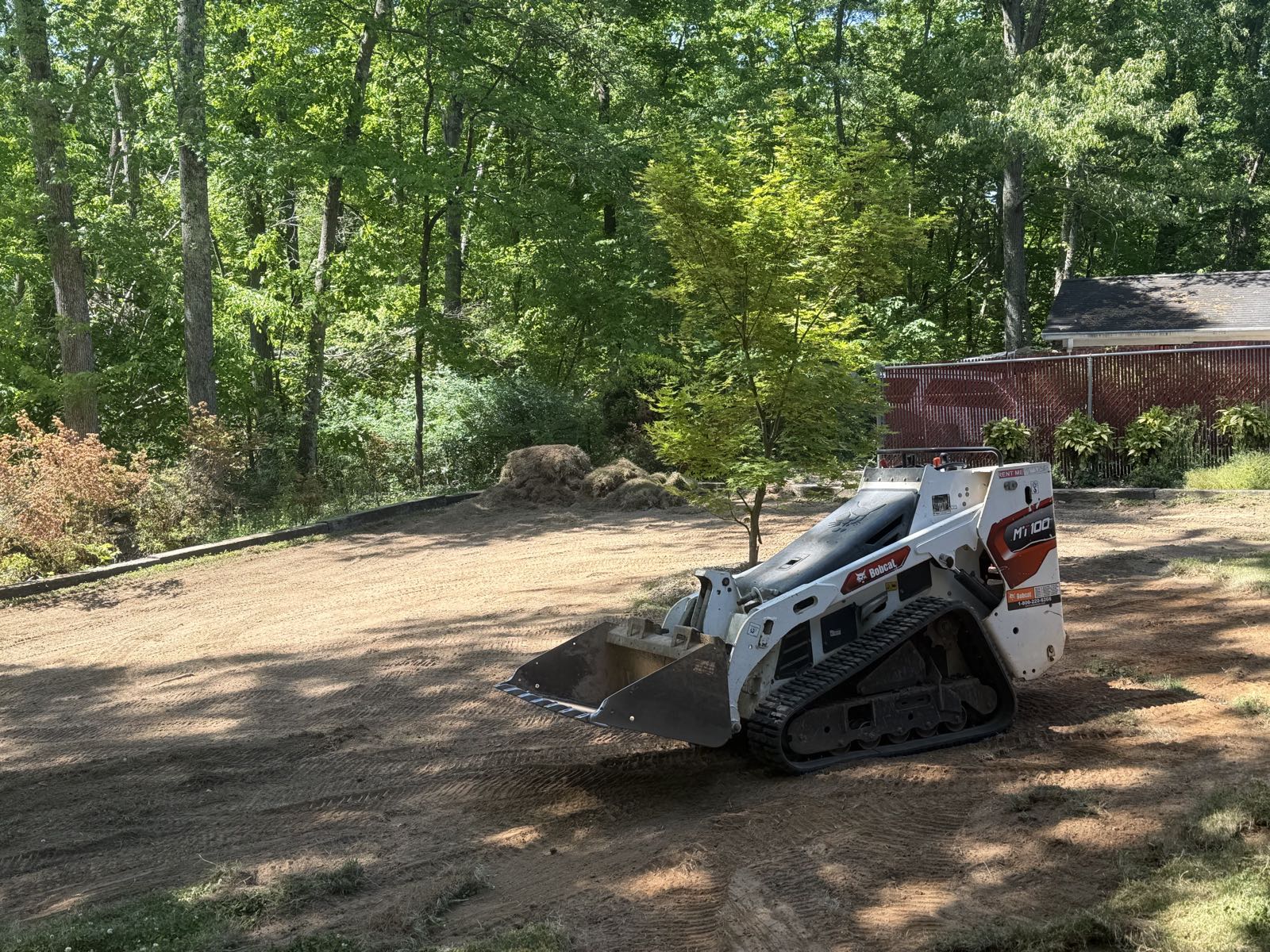
Grading is moving dirt until water has somewhere better to go. The machine cuts the mound down, carries it across, and compacts it into the low spot in lifts.
The finished surface sheds rain instead of holding it. That swale down the middle is doing the quiet work every time it storms.
- Real equipment, not shovels
- Fill compacted so it stays put
- Finished with a drainage path
How the work goes
- Downspouts carried away from the foundation
- French drains built with clean stone and filter fabric
- Fill compacted in lifts so it does not resettle
- Grades that shed water without dumping it on a neighbor
- Surface restored, not just left as bare dirt
- 01
Find where the water goes
We look at the whole path, from roof and downspouts to the low point. Most yard water problems start at a downspout.
- 02
Set the target grades
Positive fall away from the house, and a route to somewhere the water can actually leave.
- 03
Move the dirt
Cut the high spots, fill the low ones, compact the fill so it does not settle back into a puddle.
- 04
Install drainage
French drain, catch basins or solid pipe, sized and pitched, wrapped and stoned so it keeps working.
- 05
Restore the surface
Fine grade, then seed, sod or mulch so the repair does not look like a scar.
Grading & Drainage: common questions
What does a french drain cost?
Most residential french drains run $30 to $60 per linear foot installed, depending on depth, access and where the water has to go. A short run to daylight is cheap. A long run with a pop-up emitter and hand digging around utilities is not.
Why is my yard always soggy in one spot?
Usually a low point in the grade with clay underneath, fed by a downspout or by runoff from a slope. The fix is either regrading it so the water keeps moving, or intercepting the water before it gets there.
Can you fix water running toward my foundation?
Yes, and it is worth doing before it becomes a structural problem. Usually it is a combination of extending downspouts and re-establishing positive grade in the first ten feet around the house.
Grading & Drainage across the Upstate
We take this work throughout Greenville and Spartanburg counties.
Related work
-
Retaining Walls
Segmental block and natural stone walls, built on a proper base with real drainage.
Learn more -
Paver Patios
Patios, walkways and driveways laid on a compacted base that does not sink or shift.
Learn more -
Hardscaping
Stone steps, walkways, seat walls and columns that make a yard usable.
Learn more
Tell us what the yard is doing.
Free on-site estimate, no pressure and no subscription to anything. We look at it, we tell you what it takes, and you decide.